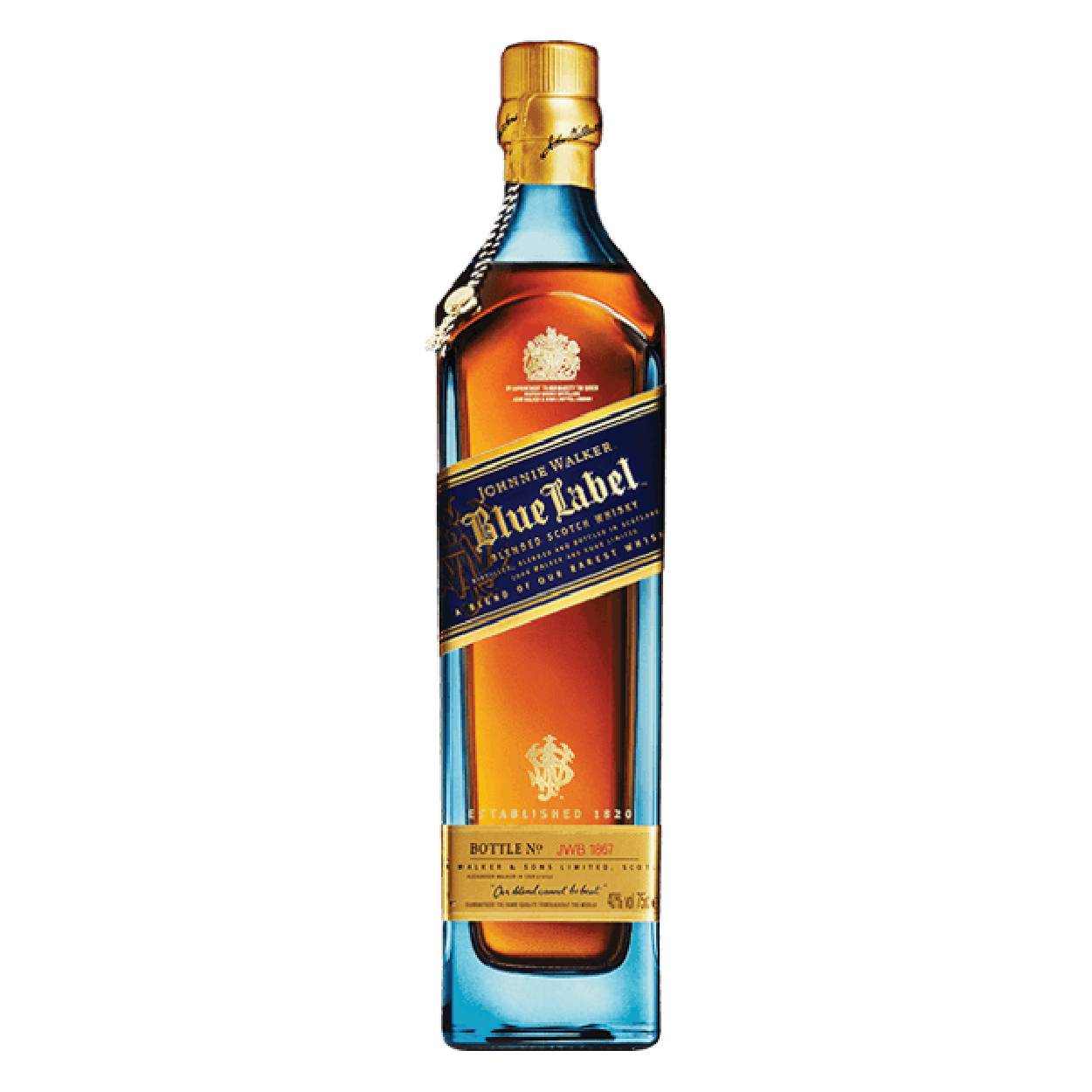
Walk into any high-end liquor store and you’ll see it. That tall, heavy, square bottle with the diagonal label, glowing with a soft blue tint behind the glass. It’s the ultimate "I’ve made it" trophy. But if you’ve actually looked at the price tag lately, you’ve probably noticed something weird. The johnnie walker blue cost is rarely the same twice. One shop has it for $174, the next wants $249, and if you're looking at a limited edition, you might be staring down $350 or more.
It's confusing. Honestly, it's a bit of a headache for anyone just trying to buy a decent gift or stock their home bar without getting ripped off. You’d think a global brand would have a set price, but the luxury spirits market doesn't work like that.
What You’ll Actually Pay: The 2026 Price Breakdown
Right now, if you are looking for a standard 750ml bottle in the United States, your "sweet spot" is roughly $175 to $210.
If you find it for under $180, you’re doing great. Big-box retailers like Total Wine or Costco often hover around that **$174.99** mark. But if you’re shopping at a boutique liquor store in a major city like New York or Chicago, don't be shocked to see it sitting at $225. They know people buying Blue Label often aren't price-shopping; they're buying the name and the convenience.
Then there’s the international factor. In Australia, for instance, you're looking at roughly $240 to $270 AUD for a standard bottle, though prices there fluctuate wildly based on import taxes. In the UK, it generally settles around £150 to £185.
Why the massive gaps?
Basically, it comes down to three things:
- State Taxes: Some states have "sin taxes" that tack on a massive percentage before you even hit the checkout.
- Inventory Cycles: If a store bought their stock six months ago before a price hike, they might still be selling at the old rate.
- The "Gifting" Markup: During the holidays or Lunar New Year, some retailers bump the price because they know it's a panic-buy for corporate gifts.
The 1-in-10,000 Myth and Reality
Johnnie Walker loves to tell you that only one in every 10,000 casks is good enough for Blue Label. It sounds like marketing fluff, but there’s a grain of truth that actually drives the johnnie walker blue cost. Unlike Black Label, which is built for consistency and volume, Blue is a blend of some incredibly old whiskies.
We’re talking about "ghost distilleries"—places like Pittyvaich or Port Dundas that don't even exist anymore. When those casks are gone, they’re gone forever. That scarcity is baked into the price. You aren't just paying for the liquid; you're paying for the fact that the Master Blender, Emma Walker, had to pick through a massive inventory to find specific barrels that haven't turned into over-oaked "wood juice" after 25+ years.
The Limited Edition Trap (or Opportunity)
If you see a bottle with a horse on it, it's going to cost you more. For 2026, the big release is the Johnnie Walker Blue Label Year of the Horse, designed in collaboration with fashion artist Robert Wun.
These "Lunar New Year" editions are huge for collectors. While the liquid inside is usually the exact same Blue Label you get in the standard bottle (bottled at 40% ABV), the packaging and "prestige" factor push the price up. You’ll typically see these retailing for $230 to $260.
Is it worth the extra $50?
If you’re drinking it? No.
If you’re putting it on a shelf or giving it to a business partner who appreciates the "Year of the Horse" symbolism? Maybe.
How to Not Overpay for Blue Label
If you want to be smart about the johnnie walker blue cost, stop buying it at the first place you see.
- Check the 200ml bottles: If you just want to taste it, don't drop $200. You can find "pocket" bottles for about **$65-$75**. It’s the same whisky, just less of it.
- The Costco Factor: If you have a membership, Costco is almost always the cheapest place on earth for Blue Label. They often have it for $169 in certain regions.
- Travel Retail: Duty-free used to be the gold standard for deals. Nowadays, it’s hit or miss. Sometimes the "1-Litre" duty-free bottle is a better value per ounce, but always check the exchange rate.
Is the High Cost Actually Justified?
This is where whisky snobs and casual drinkers clash. If you go to a site like Wine-Searcher or Reddit’s r/scotch, you’ll find plenty of people saying Blue Label is "overrated" because it’s bottled at a low 40% alcohol by volume. They’ll tell you to buy a Cask Strength single malt for half the price.
But they’re missing the point. Johnnie Walker Blue isn't trying to be a "smoke bomb" or a "sherry monster." It’s designed to be the smoothest thing you’ve ever tasted. That velvet texture is what you're paying for. It’s the "safe" luxury. You can serve it to your boss, your father-in-law, or a total stranger, and they will almost certainly like it. You can't say that about a $150 bottle of Laphroaig.
Actionable Strategy for Buyers
If you are planning to purchase a bottle this year, your best move is to aim for a price point under $190. Avoid buying at airport "Luxury" kiosks unless you've checked local prices first, as they often mark up the "exclusive" feeling. If you find a bottle of the 2026 Year of the Horse edition for under $235, grab it—those tend to appreciate in value once the year ends and the next zodiac design takes over.
Finally, if you just want the flavor profile without the "Blue" tax, try a bottle of Johnnie Walker 18 Year Old. It’s usually about $95, and while it lacks the "ghost distillery" components, it shares much of that honeyed, silky DNA for half the price.