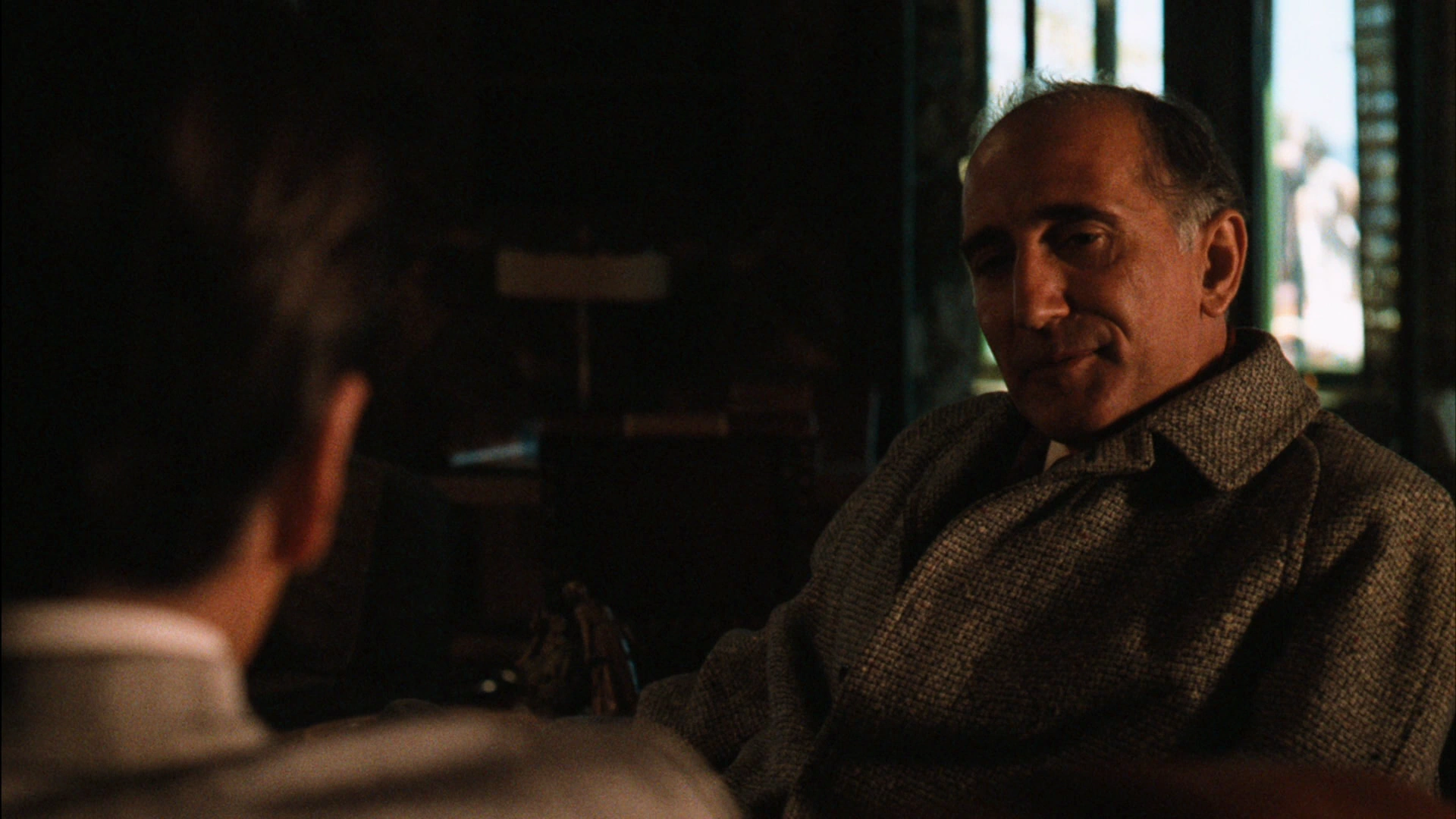
Johnny Ola is the guy you see but never really look at. In the sprawling, operatic mess of betrayal that is The Godfather Part II, he’s the whisper in the ear. He’s the bridge. He's also the reason the Corleone family almost ended up as a footnote in Nevada history.
If you’ve watched the movie a dozen times, you know the face. Dominic Chianese—years before he became Uncle Junior on The Sopranos—played Ola with this eerie, calculated politeness. He wasn’t a "button man" or a street thug. He was a messenger. Specifically, he was Hyman Roth's right hand, the man who brought the "sedition" into the Corleone house.
Johnny Ola and the Art of the Setup
Most people focus on the big moments: the shooting at Lake Tahoe, the senate hearings, the kiss of death in Havana. But the mechanics of the betrayal start with Johnny Ola. He's the one who shows up at the Corleone estate, ostensibly to talk shop about the Cuban deal.
He's slick.
He brings a gift—a piece of fruit, if I recall—and speaks with a soft, deferential tone that masks a total lack of soul. When we talk about Johnny Ola Godfather Part II lore, we’re talking about the guy who successfully manipulated Fredo Corleone. That’s his real "contribution" to the plot. He didn't use a gun; he used Fredo’s insecurity.
Fredo was the weak link. Everyone knew it. But Ola was the one who poked the bruise. He convinced Fredo that by helping Hyman Roth, Fredo would finally get something for himself, something independent of his younger brother Michael. It was a classic "divide and conquer" tactic, and it worked because Ola knew exactly how to play the "old friend" card.
The Havana Connection
In the Havana sequences, Ola is constantly hovering. He’s the facilitator for the meeting between Michael and the various corporate interests (United Fruit, etc.) that were carving up Cuba like a birthday cake.
What’s fascinating about the character is how he treats Michael versus how he treats Fredo. With Michael, he is the consummate professional. He’s respectful of the power. With Fredo, he’s a bit more casual, a bit more "buddy-buddy." It’s a performance.
Then comes the slip-up.
The moment in the Superman club where Fredo pretends he doesn't know Johnny Ola is the beginning of the end. Michael asks, "Who's that?" and Fredo says, "I never met him." Later, Fredo lets it slip that Ola took him to a place in Havana. That’s the "Aha!" moment. It’s a tiny detail, but in the world of the Corleones, a tiny lie is a death sentence.
The Real History Behind the Character
Francis Ford Coppola and Mario Puzo didn't just pull Johnny Ola out of thin air. While Hyman Roth is famously a stand-in for Meyer Lansky, Johnny Ola is loosely based on Eddie McGrath. McGrath was a real-life mobster and longshoreman boss who had significant ties to the underworld and worked as a high-level associate for more powerful figures.
The movie uses Ola to show how the "New Mafia" worked. They weren't just guys in fedoras with tommy guns anymore. They were businessmen. They were international. Ola represents the transition from the old-world Sicilian vendettas of Part I to the corporate, cold-blooded maneuvering of Part II.
Honestly, his death is almost an afterthought because he'd already done his job. When Michael's bodyguard strangles him with a coat hanger in that hospital room in Havana, it’s a quick, silent end for a man who did all his damage with words.
Why Johnny Ola Matters for the Franchise
You can't have the tragedy of Fredo without Johnny Ola.
Without Ola, Roth is just a distant old man in Miami. Ola is the physical presence of the threat. He’s the one who literally walks into Michael’s home and scouts the layout. He’s the one who coordinates with the traitors inside the house.
It’s easy to hate Fredo for his weakness, but Ola is the predator who smelled the blood in the water.
Common Misconceptions About the Betrayal
- Did Ola want Fredo dead? Probably not initially. Fredo was more useful alive as a source of information.
- Was Ola a "Made Man"? The movie stays vague on his official status within the Five Families, but he clearly carries the authority of the Chicago or Miami outfits.
- The Coat Hanger Scene: Some fans find the death scene "unrealistic," but it reflects the desperation of the Havana coup. Things were falling apart. The hit had to be fast, quiet, and improvised.
The dynamic between Ola and Roth is also worth noting. Roth treats him like a son—or at least, the version of a son a sociopath would have. When Roth later laments the death of "a friend of ours" (referring to Moe Greene in the first film), it mirrors how he eventually loses Ola. In this world, everyone is a pawn, even the most loyal lieutenants.
Deep Lore: The Deleted Context
In various drafts and deleted scenes, the relationship between the Corleones and the Roth associates was meant to be even more intertwined. The idea was to show that the families had been "in bed" together for years. Johnny Ola wasn't just a stranger; he was someone who had been around the periphery for a long time.
This makes Fredo’s betrayal even more stinging. It wasn't just a random guy he met at a bar; it was a long-term play.
If you’re looking to understand the mechanics of the "Lake Tahoe assassination attempt," you have to look at the logistics Ola would have handled. Someone had to get those shooters past the gates. Someone had to know which bedroom was Michael's. Someone had to leave the drapes open.
Ola didn't pull the trigger, but he held the map.
Actionable Takeaways for Film Buffs and Writers
If you’re analyzing The Godfather Part II or trying to write a compelling villain, Johnny Ola offers a masterclass in several areas:
1. The "Soft" Villainy Approach
Notice how Ola never raises his voice. He never threatens. He wins by being "helpful." If you're building a character or analyzing a plot, look for the person who is making things "too easy" for the protagonist. That's usually where the knife is hidden.
2. Watch the Eyes, Not the Hands
In the scene where Ola meets Michael at the estate, watch Dominic Chianese’s eyes. He is scanning the room while his mouth is busy saying polite nonsense. It’s a brilliant piece of acting that tells you exactly who the character is before he ever says a word about business.
3. Understand the "Buffer" Role
In complex organizations—and complex movies—the most dangerous person isn't the boss; it's the person who controls the flow of information to the boss. Ola was the filter between Roth and the world.
4. Re-watch the Havana Club Scene
To truly see the moment the Corleone empire cracked, watch the background of the Superman club scene. The moment Fredo waves to Ola is the exact moment the "Family" dies. It’s the ultimate proof that Michael’s internal security had failed completely.
5. Historical Context is Key
To get the most out of Johnny Ola Godfather Part II discussions, read up on the 1959 Cuban Revolution. Knowing how much money the mob actually lost when Castro took over adds a layer of desperation to Ola’s actions. He wasn't just being mean; he was trying to save a multi-million dollar investment that was literally burning down around him.
The brilliance of the character lies in his invisibility. He is the ghost in the machine of the Corleone downfall. Next time you sit down for a re-watch, ignore Michael for a second. Follow Johnny Ola. See how he moves through the rooms. See how he positions himself. You'll see a completely different movie.
To dive deeper into the technical execution of the film, research the cinematography of Gordon Willis, specifically how he used shadows to hide Ola's face during key negotiations, further emphasizing his role as a man of the shadows. Follow this up by comparing the character of Ola to the more "vocal" antagonists of the first film to see how the series' approach to villainy evolved.