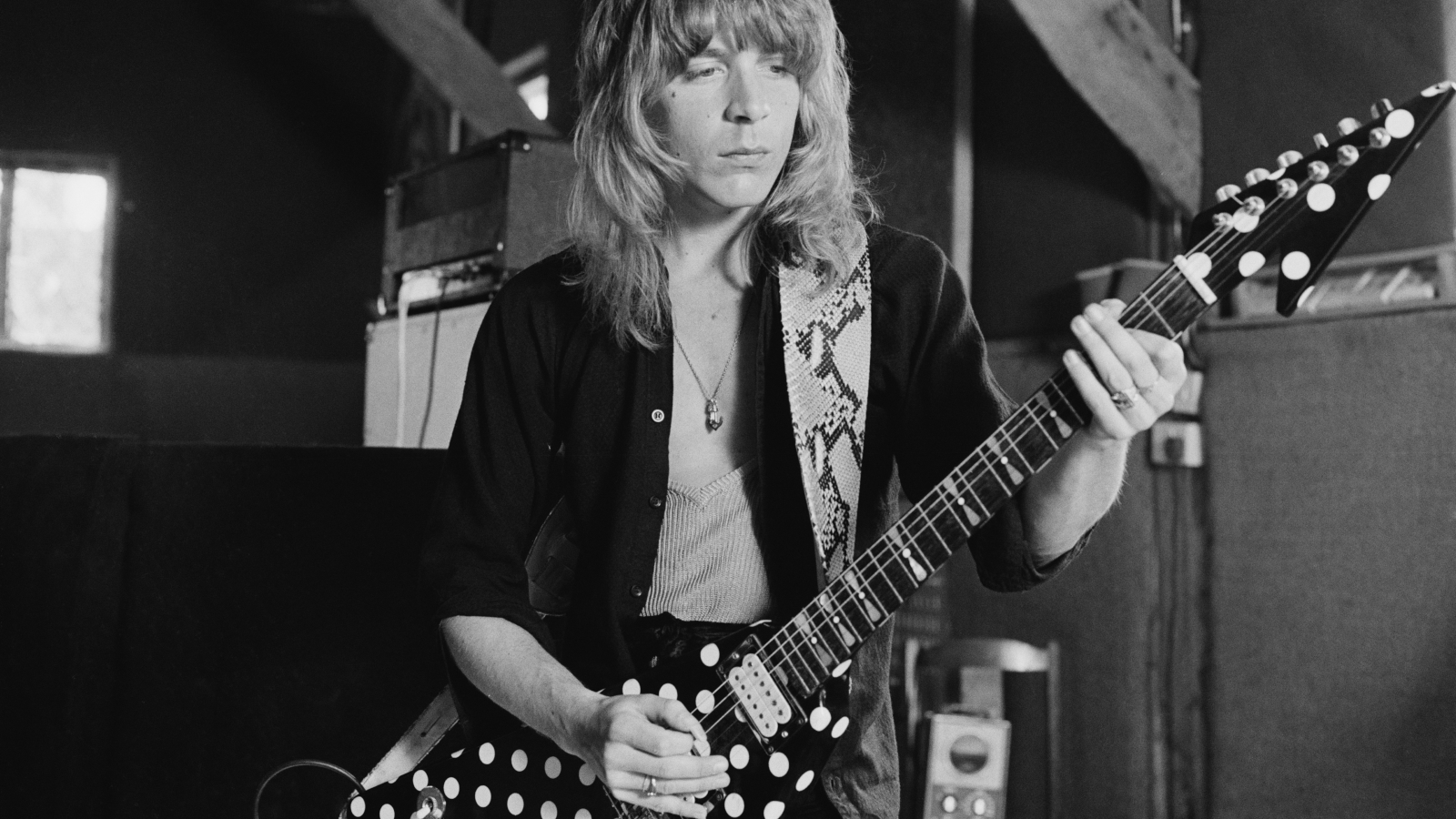
When you think about the 1980s metal explosion, one image usually sticks. It’s a guy with a polka-dot flying V, hair like a golden halo, looking way too small for the massive Marshall stacks behind him. That was Randy Rhoads. He wasn't just another shredder in a decade full of them. Honestly, he changed how people thought about the electric guitar in less than three years on the world stage.
Most players back then were basically just trying to be Eddie Van Halen. They were tapping, diving, and playing fast, sure. But Randy? He was different. He brought a sense of "architecture" to his solos. It wasn't just noise; it was music.
The Teacher Who Became a Legend
Randy Rhoads wasn't a "born rockstar" in the way we usually imagine. He was a music teacher. While other kids were out getting into trouble in Burbank, Randy was at Musonia, the music school his mom Delores ran. He started with folk and classical. By the time he was a teenager, he was already teaching other kids how to play.
You can hear that teacher's discipline in every note. Most rock guitarists at the time learned by ear, sitting by a record player and moving the needle back and forth until they got the lick right. Randy understood the why. He knew about scales, modes, and theory.
The Quiet Riot Years
Before the world knew him, Randy was the local hero of the L.A. club scene. Quiet Riot was his first real vehicle. They were huge on the Sunset Strip, but they couldn't land a U.S. record deal. It's kinda wild to think that the guy who would redefine metal could only get his first two albums released in Japan.
Those early records—Quiet Riot I and Quiet Riot II—are glimpses into a legend in training. You can hear the hunger. He was already using the polka-dot Sandoval V, but the "neoclassical" thing hadn't fully bloomed yet. He was still a bit of a glam-rocker, wearing the vests and the platform shoes.
When Ozzy Met the "Little Guy"
The story of how Randy got the gig with Ozzy Osbourne is basically rock and roll folklore. Ozzy was depressed. He'd been kicked out of Black Sabbath and was basically living in a hotel room in L.A., surrounded by empty bottles. He was holding auditions, but he hated everyone. They all sounded like Tony Iommi.
Then Randy walks in.
Ozzy famously said he thought Randy was a "little girl" at first because he was so petite and had that feathered hair. Randy plugged in his practice amp, started warming up, and Ozzy hired him before he even played a real song. "He's got it," Ozzy said.
That partnership changed everything.
Blizzard of Ozz and the Birth of a New Sound
In 1980, they released Blizzard of Ozz. If you've ever picked up a guitar, you've tried to play "Crazy Train." That riff is the "Smoke on the Water" of the 80s, but way more technical. It's built on a minor scale (F# Aeolian, for the nerds), and it has that distinct, "rolling" quality Randy was known for.
Then there’s "Mr. Crowley." The solos in that song are basically perfect compositions. They aren't just improvisations; they have a beginning, a middle, and a climax. He was using diminished scales and pedal points—things usually reserved for cello or violin players.
The Randy Rhoads Guitar Player Secret: Gear and Grit
Randy's sound was very specific. It wasn't "warm" or "smooth." It was "buzzy," mid-heavy, and had a specific bite that cut through everything.
- The 1974 Gibson Les Paul Custom: His main white guitar. It was heavy, and it had a classic rock crunch.
- The Polka-Dot V: Built by Karl Sandoval. This is the "look" everyone remembers.
- The Jackson Concorde: This was the first "Jackson" guitar. Randy wanted something that looked like a shark fin. It changed the shape of heavy metal guitars forever.
- The Pedalboard: He almost always had an MXR Distortion + on. It gave him that signature "sandpaper" grit. He also used a 10-band EQ to boost those middle frequencies so his solos would jump out of the speakers.
One of the coolest things about him? He doubled his solos. In the studio, he would play the exact same solo two or three times. Most people can't do that perfectly. Randy could. If you listen to "Over the Mountain" with headphones, you can hear the slight thickness that comes from his incredible precision.
The Tragedy in Leesburg
Everything stopped on March 19, 1982.
The band was on tour in Florida. The bus driver, Andrew Aycock, was also a pilot. He took a small plane from a private strip and started "buzzing" the tour bus where the rest of the band was sleeping. Randy was on board. He wasn't a big flyer, but he wanted to take some aerial photos for his mom.
The plane's wing clipped the bus. It spiraled into a nearby house and exploded. Randy was only 25.
It's one of those "what if" moments that still haunts music history. Randy had told friends he wanted to quit rock and roll for a while to get a master's degree in classical guitar. He was taking lessons in every city they visited. Imagine what he would have sounded like if he'd actually finished that degree.
Why We Are Still Talking About Him
Randy Rhoads didn't just play fast. He played with a sense of melody that stuck in your head. He made technical playing feel emotional.
You can see his DNA in everyone from Zakk Wylde to John Petrucci. Even players who don't play metal owe him a debt for showing that you could be a "schooled" musician and still melt faces in an arena.
How to Learn from Randy Rhoads Today
If you’re a guitar player looking to capture some of that magic, don’t just learn the tabs.
- Slow it down. Randy’s "rolling scales" are all about precision. Use a metronome. If it's sloppy, it's not Randy.
- Learn some classical. Pick up a book of Leo Brouwer or Bach. The intro to "Diary of a Madman" is heavily influenced by classical etudes.
- Think in sections. Don't just wank on the pentatonic scale. Try to write a solo that tells a story.
- Embrace the Mids. Modern metal is all about "scooping" the mids. Randy did the opposite. Turn that middle knob up on your amp and see how it helps you "sit" in the mix.
Randy Rhoads wasn't here for long, but he didn't need to be. He left a blueprint. He proved that you could be the nicest guy in the room, a dedicated student of your craft, and still be the most dangerous guitar player on the planet.
Next Steps for Your Playing
To truly understand the Rhoads style, start by analyzing the "Mr. Crowley" outro solo. Focus specifically on how he uses triad arpeggios to follow the chord changes rather than just staying in one scale box. This "vertical" approach to soloing is the quickest way to break out of a creative rut and start playing like a composer rather than just a guitarist.