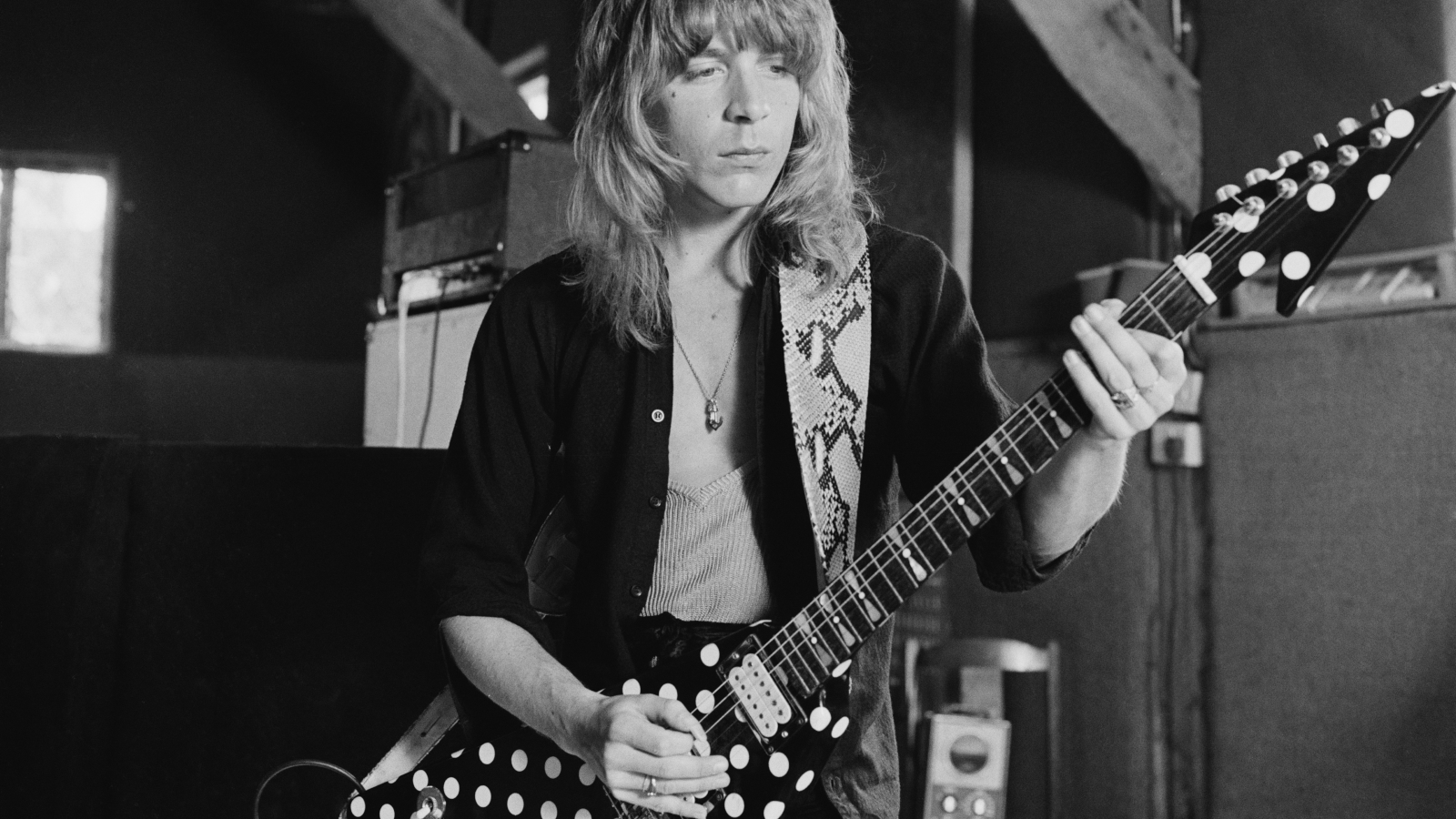
If you were hanging around the Los Angeles club scene in 1977, you might have seen a skinny kid in polka dots playing a Gibson Les Paul that looked way too big for him. That was Randy Rhoads. He wasn't a rock star yet. He was just a local guitar teacher from Burbank who happened to be the best player in town. Honestly, most people today only know him as the guy who played on "Crazy Train," but that’s like saying Da Vinci was just a guy who liked to doodle.
Rhoads didn't just play guitar; he fundamentally re-engineered how heavy metal worked. Before he showed up, metal was mostly blues on steroids. Randy brought the Bach. He brought the Vivaldi. He brought a level of academic discipline to a genre that, at the time, was mostly known for biting the heads off bats and trashing hotel rooms.
He was only 25 when he died.
The Quiet Riot Years and the Audition That Almost Didn't Happen
Randy's story starts at Musonia, the music school his mother, Delores Rhoads, founded in North Hollywood. He wasn't some self-taught rebel. He was a classically trained prodigy who started with folk and classical guitar at age seven. By 16, he was literally teaching the classes because he’d already surpassed his instructors.
He spent years grinding with Quiet Riot. They were huge in LA, but they couldn't catch a break in the States. Their first two albums were only released in Japan. Imagine being that good and having the industry tell you that "Van Halen is already the LA band."
Then came 1979. Ozzy Osbourne had just been kicked out of Black Sabbath and was holed up in a hotel room, probably in a state of terminal intoxication. Dana Strum—who would later be in Slaughter—basically forced Randy to go audition. Randy didn't even want to go. He thought Ozzy was just a "drunk singer from a dinosaur band."
He showed up with a small practice amp and started warming up. Ozzy, barely conscious, heard a few riffs and hired him on the spot. He literally said, "Am I that stoned or is this guy that good?"
Why Every Modern Metal Solo Still Sounds Like Randy Rhoads
What made him different? It wasn't just speed. It was the composition.
Most 70s guitarists used the pentatonic scale—the "blues box." It’s a great scale, but it’s limited. Randy used the Aeolian mode, the Phrygian mode, and the Harmonic Minor. He used "rolling scales" and pedal points. If you listen to the solo in "Mr. Crowley," you aren't just hearing a guy shredding; you're hearing a mini-symphony with a beginning, a middle, and a climax.
He was obsessed with "double-tracking" his solos. This is a nightmare to do. You have to play the exact same solo twice, perfectly, so the layers thicken the sound. Randy was so precise that he could triple-track a solo and it would sound like one massive, crystalline guitar.
The Gear: More Than Just a Polka Dot V
People obsess over his 1979 Karl Sandoval Flying V with the polka dots, but his real contribution to gear was the Jackson Concorde. He wanted a guitar that looked like a weapon. He worked with Grover Jackson to design an asymmetrical V with a longer horn.
Grover was actually scared to put the "Charvel" name on it because it was so radical, so he put his own last name on the headstock. That’s how Jackson Guitars was born. Without Randy, that entire aesthetic of "pointy" metal guitars probably wouldn't exist.
March 19, 1982: The Day the Music Stopped
The details of the crash are still frustrating to read 44 years later. The band was in Leesburg, Florida. The bus driver, Andrew Aycock, was a private pilot with an expired license. He took a small Beechcraft F35 for a joyride while everyone was sleeping.
On the fourth pass, trying to "buzz" the tour bus to wake everyone up, the wing clipped the roof of the bus. The plane spiraled, hit a tree, and slammed into a garage. Randy, Aycock, and seamstress Rachel Youngblood were killed instantly.
Ozzy was asleep in the back of the bus. He woke up to the explosion.
He never really got over it. In his 2021 Rock and Roll Hall of Fame induction video, Tom Morello (who named his son after Randy) said you could study Randy’s songs in a university musicology class or bang your head to them in a 7-11 parking lot. That’s the perfect summary. He was high art and low-brow grit all at once.
How to Play Like Rhoads (Or At Least Try)
If you’re a guitar player trying to capture that 1981 magic, you’ve got to change your mindset.
- Learn Your Theory: Randy wasn't guessing. He knew why a diminished chord worked over a certain bass note.
- Practice Slow: His "rolling scales" come from classical discipline. If you can't play it clean at 60 BPM, you have no business playing it at 140.
- Use the MXR Distortion+: That’s a huge part of his "fizzy" but articulate tone. He didn't use a ton of gain; he used just enough and let his fingers do the work.
- The "Dee" Exercise: Learn his acoustic piece "Dee." It’s short, but it teaches you more about chord voicing than a year of YouTube tutorials.
Randy Rhoads didn't want to be a rock star forever. Right before he died, he was talking about quitting the road to get a master’s degree in classical guitar at UCLA. He just wanted to be a student. That’s the real lesson: no matter how good you get, never stop taking lessons.
Go listen to the live version of "Suicide Solution" from the Tribute album. Listen to the way he uses the feedback. It’s controlled chaos. It’s perfect.
To really understand his influence, your next step should be to pull up a tab of the "Mr. Crowley" outro solo and look at the note choices. Don't just play them—look at how they relate to the chords underneath. You'll see a map of a genius at work.