You're sitting in a gymnasium, the air is stale, and your wrist already hurts from the multiple-choice section. Then you flip the page. The Document Based Question (DBQ) stares back at you. Honestly, it’s the monster under the bed for most AP European History students. But here is the thing about the 2025 euro dbq rubric—it isn’t actually designed to fail you. It’s a checklist. If you treat it like a scavenger hunt instead of an essay, you win.
The College Board hasn't fundamentally broken the system this year, but they’ve certainly refined what they want to see regarding evidence and that elusive "Complexity" point. Most people think they need to write like a 19th-century philosopher to get a high score. They don't. You just need to be organized. You need to show the readers that you aren't just a parrot repeating what the documents say, but a historian who understands why the documents were written in the first place.
What changed with the 2025 euro dbq rubric?
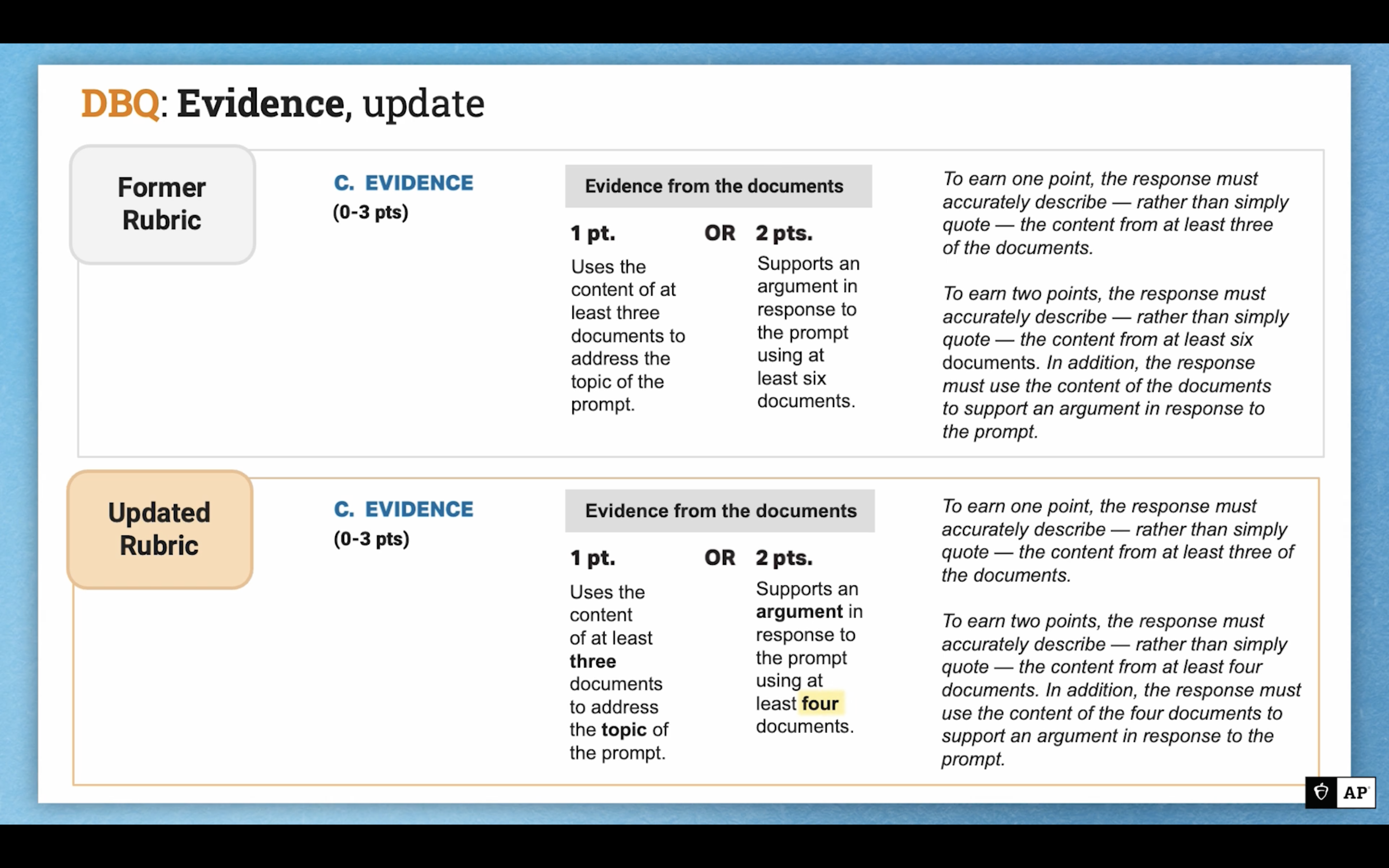
If you’ve been looking at older practice exams from five or six years ago, stop. The scoring has shifted toward rewarding "use" of evidence rather than just "mentioning" it. For the 2025 euro dbq rubric, the biggest hurdle remains the analysis of source perspective. You can’t just say, "Document 1 is a map of the French Revolution." That’s useless. The graders are looking for the why. Why did this specific cartographer draw the borders this way in 1792? Was he trying to please a Jacobin committee? Was he an exile in London trying to show the "chaos" of the republic? That is the difference between a 3 and a 7.
The rubric still rests on those core pillars: Thesis, Contextualization, Evidence from Documents, Evidence Beyond the Documents, and Analysis. But the "Complexity" point—often called the unicorn point—is where the 2025 standards get picky. You don't get it for just writing a long essay. You get it by weaving a counter-argument throughout the entire piece. It’s about nuance. It's about saying, "While the Industrial Revolution certainly improved the middle-class standard of living, it simultaneously decimated the traditional family structure of the urban poor."
Contextualization isn't just a "Once upon a time"
Everyone starts their DBQ with something like "Throughout history, people have fought." Please, don't do that. The 2025 euro dbq rubric requires specific context. If the prompt is about the Protestant Reformation, your context shouldn't start with the Romans. It should start with the printing press, the corruption of the Borgia popes, or the rise of Christian Humanism with Erasmus. Think of it like a movie trailer. You need to set the scene so the viewer knows exactly where and when we are before the action starts.
Context is worth one point. It’s the easiest point to get if you just give three to four sentences of solid, factual background that leads directly into your thesis. If you're talking about 19th-century imperialism, mention the Berlin Conference or the Maxim gun. Don't just say "Europeans wanted land." Be precise. Precision is the currency of the AP Euro grader.
The Thesis: Your North Star
Your thesis is the most important sentence in the entire booklet. If your thesis is weak, the rest of the essay is a house of cards. The 2025 euro dbq rubric demands a "historically defensible claim" that establishes a "line of reasoning."
"The French Revolution was caused by many things" is a bad thesis.
"While the Enlightenment provided the intellectual framework for the French Revolution, the immediate catalysts were the crown’s fiscal insolvency and a series of catastrophic harvests that radicalized the Parisian third estate." That? That is a thesis that tells the reader you know your stuff. It sets up two distinct body paragraphs and acknowledges a "while" clause, which already puts you on the path to the complexity point.
Sourcing is where the points live or die
You have to use seven documents. Use all of them. Seriously. Even if you don't fully understand Document 4, find a way to fit it in. If you only use six, you’re playing with fire. If you misinterpret one and you only used six, you lose the "Evidence from Docs" point entirely.
But "using" a document isn't just quoting it. Never quote more than five words in a row. Paraphrase. Summarize. Then, do the HIPP analysis:
- Historical Situation: What was happening right then?
- Intended Audience: Who was supposed to read this?
- Purpose: Why was it written?
- Point of View: Who is the author and what are their biases?
For the 2025 euro dbq rubric, you need to do this for at least three documents. If you’re smart, you’ll do it for five just in case you mess a couple up. If you're looking at a speech by Bismarck, don't just tell me he wants to unify Germany. Tell me he's speaking to the Prussian Landtag and he's trying to convince liberals to vote for military budgets by appealing to their nationalism. That’s HIPP. That’s how you get the points.
The Evidence Beyond the Documents trick
You need one piece of outside information. Just one. But it has to be a "specific historical example" not mentioned in the documents. If the DBQ is about the Cold War and none of the documents mention the Hungarian Uprising of 1956, bring it in. Describe it. Explain how it supports your argument.
Don't just drop a name like "Napoleon." Explain a specific action, like the Napoleonic Code or the Continental System. The 2025 euro dbq rubric is looking for depth. Think of outside evidence as your chance to show the grader that you actually read the textbook and didn't just show up to the exam for the snacks.
The "Unicorn" point: Complexity explained simply
Complexity is the hardest point to earn on the 2025 euro dbq rubric. About 90% of students won't get it. But you can.
The easiest way is "Comparison." If the prompt asks about the causes of the Russian Revolution, spend your conclusion or a dedicated paragraph comparing those causes to the French Revolution. Note the similarities—failing monarchies, bread riots—but also the differences, like the role of Marxist ideology versus Enlightenment liberalism.
Another way is "Continuity and Change." If you’re arguing that the Scientific Revolution changed everything, acknowledge what stayed the same. Most peasants in 1650 didn’t care about Copernicus; they were still living in a world of folklore and seasonal cycles. By showing that you understand the "grey areas" of history, you earn that complexity point. It's about being a "sophisticated" thinker.
Common mistakes to avoid in 2025
- Laundry Listing: This is when you just go "Doc 1 says this. Doc 2 says that. Doc 3 says this." That's not an essay; it's a list. Group your documents into themes.
- Misidentifying the prompt: If the prompt asks for social effects and you write about political ones, you’re in trouble. Read the prompt three times. Circle the "action" words.
- Running out of time: Spend 15 minutes planning. If you don't have an outline, you'll wander.
- Ignoring the "Euro-ness": This isn't World History. Focus on the specific European tensions—the balance of power, the role of the Church, the impact of class.
Actionable Steps for the Exam Room
If you want to master the 2025 euro dbq rubric, you need a game plan. When the clock starts, don't just start writing.
- Step 1: Spend the first 10 minutes reading the documents and jotting down a one-word theme for each.
- Step 2: Group them. You need at least two groups, preferably three. "Economic causes," "Religious tensions," and "External pressures" are classic groupings.
- Step 3: Write your thesis last in your planning phase. Make sure it actually answers the prompt.
- Step 4: Write the essay. Start with your context, hit your thesis, and then move into your body paragraphs.
- Step 5: As you use a document, check it off your list. Make sure you’ve done HIPP for at least four of them.
The rubric is a map. If you follow the path, you get the 7. It doesn't matter if your handwriting is messy or if you forget the exact date of a specific battle. What matters is the logic. Show the reader that you see the connections between the documents and the larger flow of European history.
To prep for this effectively, take a past DBQ—like the 2022 one on the English Civil War—and try to rewrite the thesis using the "While [Counter Argument], [Your Main Argument] because of [Evidence 1] and [Evidence 2]" formula. This practice alone will elevate your writing to the level the 2025 graders are looking for. Focus on making your arguments "multidimensional." If you can see two sides of a historical conflict, you're already ahead of most of the country.
Once you have the structure down, the content becomes secondary. You can have all the facts in the world, but without the rubric-driven structure, they won't earn you the score you deserve. Master the rubric, and you master the exam.