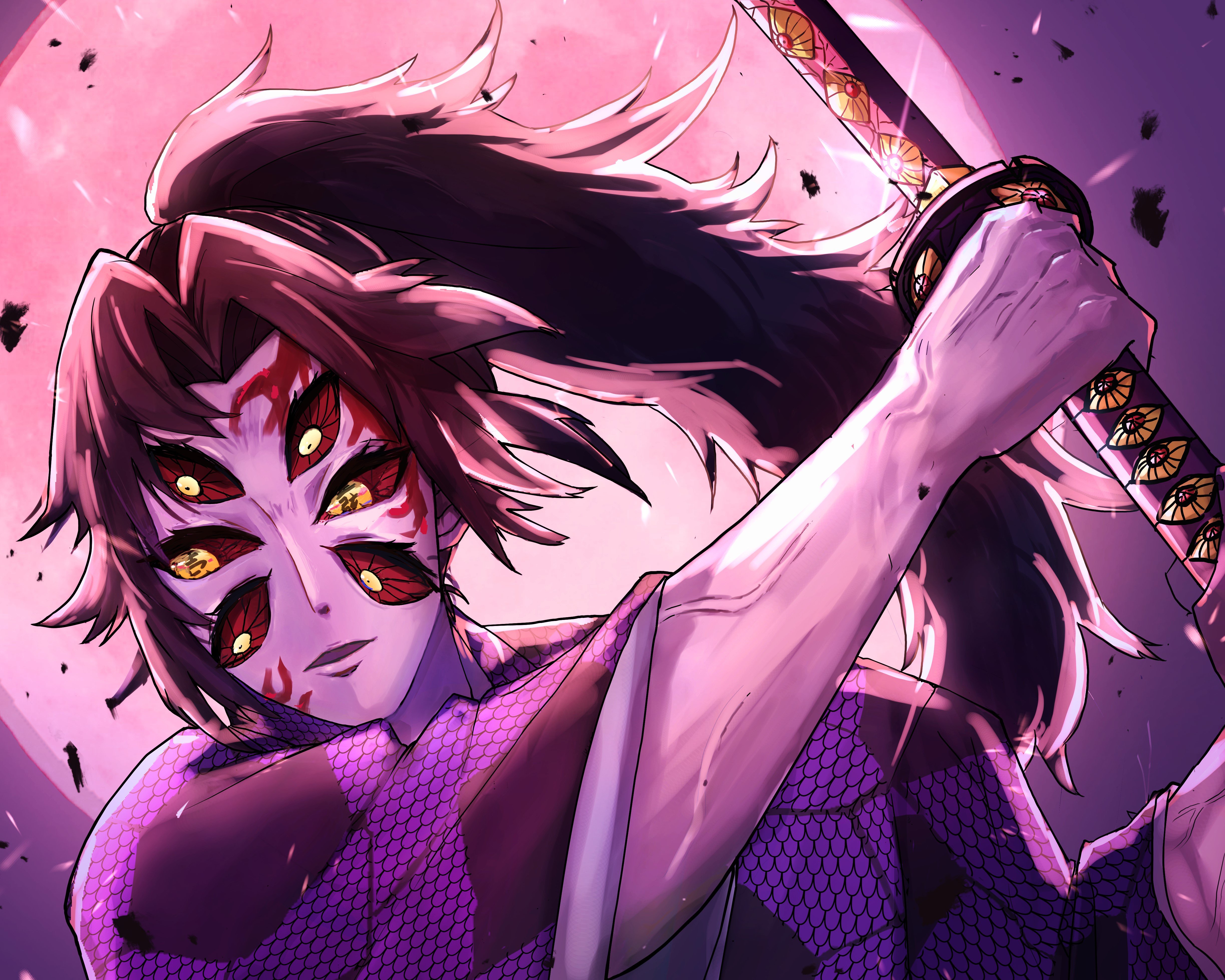
The Entertainment District arc changed everything for Demon Slayer. It wasn’t just the flashy animation or the high-stakes battle in Yoshiwara. It was the introduction of Upper Moon 6. Most fans remember the sheer terror of Daki and Gyutaro, but there’s a lot more to their story than just being high-ranking villains in Muzan’s army. They weren't just monsters. They were a reflection of a society that failed them long before they ever grew fangs.
Honestly, the dynamic between these two siblings is probably the most complex relationship Koyoharu Gotouge ever wrote. You’ve got Daki, who carries herself with the arrogance of a queen, and then you’ve got Gyutaro, the shadow lurking literally inside her. It's a weird, symbiotic nightmare.
Who Actually Holds the Title of Upper Moon 6?
This is where people get confused. Is it Daki? Is it Gyutaro? Well, technically, it’s both of them. They are a dual entity. Muzan Kibutsuji, who isn't exactly known for his generosity, allowed this unique arrangement because Gyutaro is the true powerhouse. Daki is the face; Gyutaro is the fist.
If you look at the numbers, Daki on her own probably doesn't quite hit the "Upper Rank" benchmark. She’s strong, sure. She’s eaten dozens of Hashira over the centuries. But she lacks that raw, unstoppable lethality that defines the top six. Gyutaro is the one who actually holds the rank in his eyes. He's the one who’s killed fifteen Hashira. He’s the one with the lethal Blood Demon Art that involves poison.
Without Gyutaro, Daki would have been decapitated and disintegrated within the first few chapters of the arc. But because they are "one," you have to cut both their heads off simultaneously. That’s a massive tactical advantage. It’s a gimmick, but a deadly one.
The Tragedy of the "Ume" Name
Before they were demons, they were humans living in the lowest rungs of the Entertainment District. This part of the story is brutal. Daki’s human name was Ume. It sounds pretty, right? Like a plum blossom.
Wrong.
In the context of the red-light district, "Ume" was often shorthand for "Ume-doku," or syphilis. It’s a disgusting, cruel irony. She was named after the disease that killed her mother. Gyutaro was born ugly and despised, treated like a "dirty thing" by everyone around him. He found his only sense of pride in his sister’s beauty. When she was burned alive by a samurai, his world ended. That’s the moment Doma—the then-Upper Moon 6—found them and offered them a "way out."
Most people don't realize that Doma was actually the one who turned them. He wasn't Upper Moon 2 yet. He was just a guy passing by who thought their misery was interesting.
Understanding the Blood Demon Art: More Than Just Sashes
Daki’s ability revolves around her Obi sashes. It’s versatile. She can store people inside them, sort of like a living pantry. It’s creepy. They move like snakes and can cut through buildings. But let's be real: Gyutaro’s Blood Demon Art, "Flying Blood Sickles," is the real threat.
His blood is pressurized. It’s poisonous. If a Hashira gets even a tiny scratch from his sickles, they are on a ticking clock. Tengen Uzui only survived as long as he did because he had a high resistance to poison. Anyone else? Dead in minutes.
The coordination between the two is what makes Upper Moon 6 so hard to kill. Daki provides long-range support and aerial surveillance from the rooftops, while Gyutaro engages in close-quarters combat. It’s a perfect military-style pincer movement.
Why Kaigaku Eventually Replaced Them
After the battle in Yoshiwara, the seat of Upper Moon 6 was vacant. Eventually, Kaigaku—Zenitsu’s former senior disciple—took the spot.
He was a joke.
Seriously, compared to Daki and Gyutaro, Kaigaku was a massive step down. He only got the position because Muzan was desperate to fill the ranks before the final battle at the Infinity Castle. Kaigaku didn't have the centuries of experience or the shared soul bond that made the previous duo so formidable. Yushiro even points this out during the final arc, mocking Kaigaku for being a "fill-in."
The difference in power is staggering. While Daki and Gyutaro required a Hashira, three high-level slayers, and two kunoichi to bring down, Zenitsu managed to solo Kaigaku (granted, with a very cool new Seventh Form). It goes to show that the original Upper Moon 6 was a tier above most demons.
The Misconception About Their Defeat
People often say Tengen Uzui was the "weakest" Hashira because he struggled so much against these two. That’s a bad take.
Tengen had to fight while protecting civilians, managing his wives, and dealing with a lethal poison circulating through his veins. He also had to keep pace with Gyutaro’s insane speed. The fact that he lived is a testament to his "Musical Score" technique.
The real reason they lost? Hubris.
Gyutaro spent too much time mocking Tanjiro. He could have finished the fight several times over. But he wanted to see Tanjiro suffer because he saw his own past self in the boy. He saw a brother trying to protect a sister and it pissed him off. That emotional baggage was their undoing. If Gyutaro had been as cold-blooded as Akaza or Kokushibo, the series would have ended right there in the snow.
How Their Bond Mirrors Tanjiro and Nezuko
The parallels are everywhere. You can't miss them. Tanjiro and Nezuko are the "what if" version of Daki and Gyutaro.
- Both pairs are siblings surviving in a harsh world.
- Both brothers would do anything to protect their sisters.
- Both sisters have a unique physical connection to their brothers.
The difference lies in who they met at their lowest point. Tanjiro met Giyu Tomioka, who showed him mercy and a path toward redemption. Gyutaro met Doma, who gave him a path toward vengeance and consumption.
It’s a nature vs. nurture argument wrapped in a shonen battle. When they are in the afterlife (or the "hell" equivalent in Demon Slayer), Gyutaro tries to push Daki away. He wants her to go toward the light. He wants her to have a better life even in death. But she refuses. She chooses to go with him into the fire. It’s heartbreaking.
Key Takeaways for Fans and Collectors
If you're looking into the lore or collecting merchandise related to Upper Moon 6, keep these details in mind to ensure you're getting the full picture.
- The Number 6 Identity: In the anime and manga, look for the kanji in their eyes. Daki has it in one, Gyutaro has it in both. This signifies their shared status.
- The Poison Factor: Gyutaro’s sickles aren't just sharp; they are coated in his own blood which acts as a necrotizing agent.
- The "Obi" Sentience: Daki's sashes have their own consciousness to a degree. They can act independently even if she isn't directly controlling them.
- Ranking Nuance: While they are the lowest of the Upper Moons, they held the position for over a century. That’s a longer tenure than many slayers’ entire family lineages.
When revisiting the Entertainment District arc, pay attention to the sound design when Gyutaro moves. It’s meant to sound unsettling—like bones clicking together. His physical design is a direct manifestation of his malnutrition and the "ugliness" he was told he possessed as a human.
To truly understand the depth of these characters, compare their final dialogue to Tanjiro’s reaction. Tanjiro doesn't celebrate. He covers Gyutaro’s mouth because he doesn't want the last words between siblings to be words of hate. He recognizes that, under different circumstances, he could have been the one standing in those ashes.
For anyone looking to dive deeper into the technical stats of the Upper Moons, checking out the Demon Slayer: Kimetsu no Yaiba – The Official Fanbook provides specific heights, weights, and even the "likes/dislikes" of the siblings that didn't make it into the main series. For instance, Gyutaro actually liked collecting things, which explains his hoarding of "treasures" in the district.
The legacy of Upper Moon 6 isn't just their power. It’s the reminder that the monsters we fear were often once victims we ignored. That's what makes them the best villains in the show.
Actionable Insights:
- Re-watch the "Musical Score" sequence: Focus on the rhythm of the battle. It shows how Tengen had to adapt to two distinct fighting styles at once.
- Analyze the Color Palette: Notice how Daki and Gyutaro use vibrant greens and pinks that clash with the traditional reds and blues of the Slayers, symbolizing their "poisonous" presence in a beautiful city.
- Read Chapter 92-97: The manga offers slightly more internal monologue from Gyutaro regarding his resentment of "blessed" people, which adds another layer to his combat motivation.