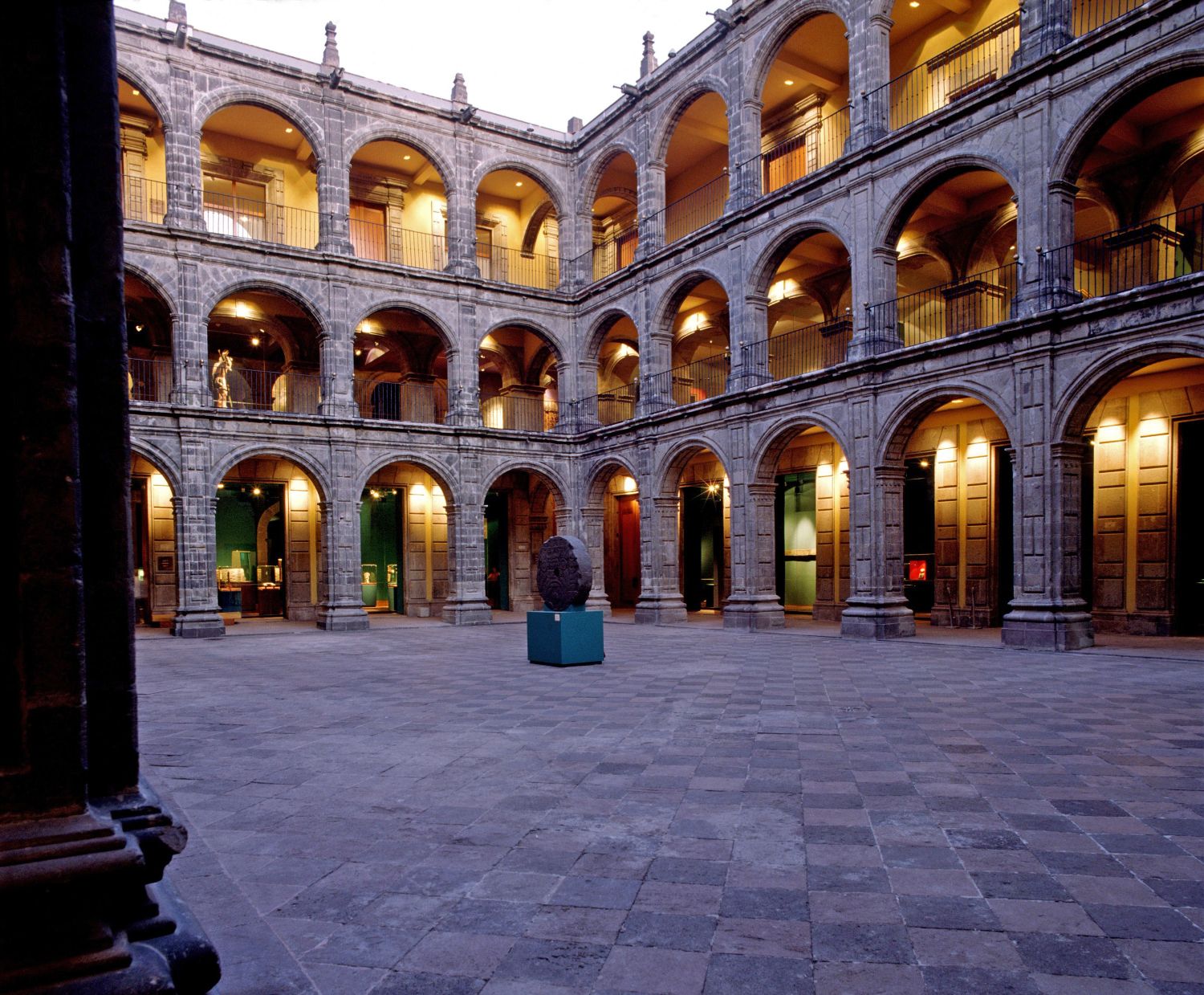
Walking through the massive doors of the Antiguo Colegio de San Ildefonso in Mexico City feels less like entering a museum and more like stepping into a giant, stone-carved brain. It's heavy. The air smells like old volcanic rock and floor wax. If you’ve spent any time in the historic center, you’ve probably walked past its tezontle walls without realizing that this single building basically birthed the modern Mexican identity. It isn’t just a pile of rocks. It’s the cradle of Mexican Muralism.
Most people visit to snap photos of the courtyards, but they miss the weird, chaotic history that makes this place actually interesting.
The story starts way back in 1583. The Jesuits—who were basically the intellectual special forces of the Catholic Church—wanted a place to consolidate their smaller seminaries. They weren't messing around. By the mid-1700s, they had rebuilt the place into the sprawling Baroque masterpiece we see now. But here’s the kicker: they didn't get to keep it. In 1767, King Charles III of Spain got nervous about how much power the Jesuits had and kicked them out of the entire Spanish Empire.
San Ildefonso went through a bit of an identity crisis after that. It was a barracks. It was a school. It was even a temporary jail. Eventually, it became the National Preparatory School in 1867. This is the era that really changed everything because it’s where a bunch of rowdy, brilliant teenagers like Frida Kahlo and Octavio Paz spent their formative years.
The Muralist Explosion of 1922
If you want to understand why San Ildefonso is a big deal, you have to look at the walls. Literally.
After the Mexican Revolution, the government realized most of the population couldn't read. How do you teach a nation about its new identity if you can't use books? You use paint. José Vasconcelos, the Minister of Education at the time, had this wild idea to give the walls of public buildings to artists. He basically said, "Here’s some paint, go tell the story of Mexico."
Diego Rivera, David Alfaro Siqueiros, and José Clemente Orozco—the "Big Three"—all started here.
Rivera’s first mural, The Creation, is in the Bolívar Amphitheater. Honestly, it’s kinda weird compared to his later work. It looks very European, almost Byzantine. He hadn't quite found his "Mexican" voice yet. But then you walk into the main courtyards and see Orozco’s work, and it hits differently. Orozco wasn't interested in making things look pretty. He painted the struggle. He painted the pain of the revolution. His murals, like The Trench, are jagged and dark. They make you feel a bit uncomfortable, which was exactly the point.
Beyond the Big Three
While everyone talks about the men, San Ildefonso was also a backdrop for the complicated social lives of these artists. This is where Frida Kahlo first saw Diego Rivera working on his scaffold. She was a student; he was a famous (and very married) artist. She used to play pranks on him, calling him "panson" (fatty) from the courtyards.
The building also houses work by Jean Charlot and Fernando Leal. Leal’s The Feast of the Lord of Chalma is fascinating because it captures that collision of indigenous tradition and Catholic ritual that defines Mexico. It’s messy. It’s colorful. It’s exactly what the building represents: a fusion of eras.
Architecture That Breathes
The building itself is a masterpiece of New Spanish Baroque. You've got three main courtyards: the Chico, the Pasantes, and the Grande.
The "Tezontle" stone—that reddish, porous volcanic rock—gives the facade its distinct texture. It’s paired with "Chiluca," a greyish stone used for the ornamental bits. This wasn't just an aesthetic choice; these materials were what was available. They are the literal earth of the Valley of Mexico.
When you walk through the Colegio de San Ildefonso, pay attention to the staircases. The proportions are massive. It was designed to make you feel small, but also part of something grand. The Jesuits believed that architecture should elevate the mind. Even if you aren't religious, you feel that "elevation" when you're standing in the middle of the main courtyard looking up at the sky.
The Secret Life of the National Preparatory School
For over a century, this was the place to be educated in Mexico. If you were anyone in the Mexican intellectual scene during the early 20th century, you probably walked these halls.
- Octavio Paz: The Nobel laureate wrote about his time here.
- Frida Kahlo: She was one of only 35 girls in a school of 2,000 students.
- Salvador Novo: A legendary writer who helped shape the city's queer history.
The "Prepa 1," as it was known, wasn't just about books. It was about political debate. The students were notoriously rebellious. They argued about Marxism, Surrealism, and the future of the country while sitting on these very steps. It was a pressure cooker for ideas.
What Most Tourists Get Wrong
Many people visit San Ildefonso as a "check-the-box" museum trip. They walk in, look at the Rivera mural, take a selfie, and leave. That’s a mistake.
The real magic is in the layers. Look at the graffiti. No, not modern spray paint, but the etchings in the stone from students who were here 100 years ago. Look at the way the light hits the arches at 4:00 PM. The building is a living organism.
Also, don't ignore the temporary exhibitions. While the murals are permanent, the Colegio has a reputation for hosting some of the most cutting-edge contemporary art shows in the city. They’ve had everything from Ron Mueck’s giant hyper-realistic sculptures to deep dives into the history of Islamic art. It’s this weird mix of 18th-century stone and 21st-century ideas that keeps it relevant.
Practical Insights for Your Visit
If you’re planning to go, don't just wing it. The Historic Center is a maze, and San Ildefonso is tucked away on Justo Sierra Street. It’s usually quieter on weekday mornings.
Entry and Timing
The museum is typically closed on Mondays. Sundays used to be free, which means they get incredibly crowded. If you actually want to see the art without a sea of heads in your way, go on a Tuesday or Wednesday morning.
The Mural Walk
Start on the ground floor and work your way up. The murals are organized somewhat chronologically and by floor. The third floor has some of the most intense Orozco pieces. Take your time. Don't try to "read" every mural in one go. Pick one and sit with it for ten minutes. You’ll notice details—a hand gripping a rifle, the expression of a mother, a hidden symbol—that you’d miss if you were just skimming.
The Surrounding Area
San Ildefonso is right behind the Templo Mayor and the Cathedral. It’s part of the sacred precinct of the Aztecs. When you’re standing in the courtyard, you are literally standing on top of history. There are layers of Aztec ruins just a few meters beneath your feet.
Why It Still Matters in 2026
We live in a world of digital screens and fleeting images. San Ildefonso is the opposite. It’s heavy, permanent, and tactile. It reminds us that art isn't just decoration; it's a way for a society to talk to itself.
The murals here were meant to be the "people's textbook." Today, they serve as a reminder of Mexico's resilience and its obsession with self-definition. Whether you’re an art history nerd or just someone looking for a cool place to escape the chaos of Zócalo, this building offers a sense of perspective that’s hard to find elsewhere.
Actionable Steps for Your Visit:
- Check the Schedule: Visit the official San Ildefonso website before you go to see which temporary galleries are open, as some sections close for installation.
- Focus on Orozco: While Rivera is the "famous" one, Orozco’s work at San Ildefonso is arguably more powerful and site-specific. Spend extra time in the main stairwell.
- Hire a Guide: If you can find a local guide outside or book one in advance, do it. The stories about the student rebellions and the specific political jabs hidden in the murals are worth the extra cost.
- Photography Rules: You can usually take photos, but no flash. The guards are strict about this because the light damages the pigments in the frescoes.
- Eat Nearby: Head to Limosneros or Café de Tacuba afterward. You’ll need a place to sit and process everything you just saw.
San Ildefonso isn't a dead monument. It's a conversation that started in 1583 and is still going on. Every time someone looks at Orozco's The Trinity and feels a spark of anger or awe, the building is doing exactly what it was built to do.